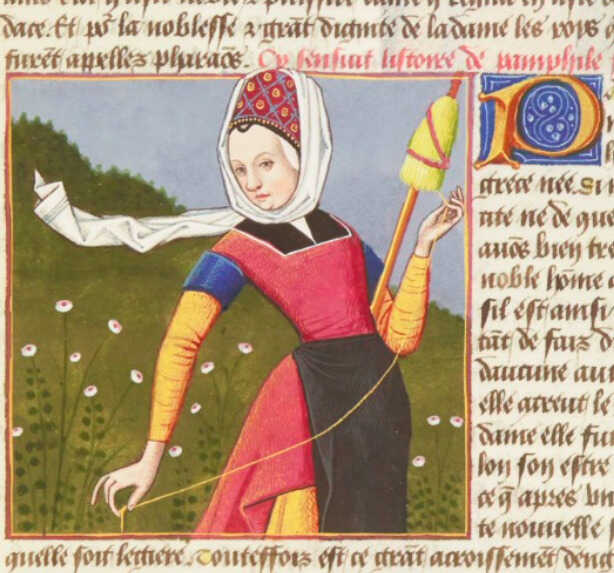
Illustration for Boccaccio’s manuscript “De mulieribus claris”, written between 1488 and 1496. Source: https://commons.wikimedia.org/
ler em português
leer en español
Part I
The fluorescent lights of Dr. Aris’s clinic hummed with a sterile indifference that contrasted sharply with the oddity unfolding on the examination table. Martha, sixty-four and weary from decades of what she called “the heavy weather of living,” sat perched on the edge of the crinkly paper sheet. She complained of a strange bump at the crown of her head—an itch that felt less like an irritation and more like a secret. Dr. Aris parted Martha’s graying hair, but she found neither cyst nor mole. Instead, she discovered a translucent, iridescent filament, finer than a spider’s silk, protruding from a microscopic pore. It pulsed with a faint, rhythmic amber light. With surgical pliers, Aris gripped the thread and pulled. It slid out with the effortless grace of a silk ribbon from a spool.
As the doctor began to twirl the pliers like a fork in spaghetti, a shimmering, sticky mass began to grow. The more the string unspooled, the more Martha transformed. Her slumped shoulders squared, and her skin, once paper-thin and dry, began to glow with a sudden, dewy hydration. She let out a low, musical giggle, remarking that it felt as though someone were finally unhooking the anchors. The doctor, mesmerized by the strange harvest, did not stop until the mass had grown from the size of a golf ball to a dense, glowing grapefruit of yarn—a chaotic tangle of the patient’s accumulated burdens. When the final inch of the filament snapped free of Martha’s skull, the room seemed to vibrate. Martha’s back arched, her breath hitched in a sharp, crystalline crescendo, and she collapsed into the chair in the throes of a profound, full-body release.

alfredobehrens@gmail.com