
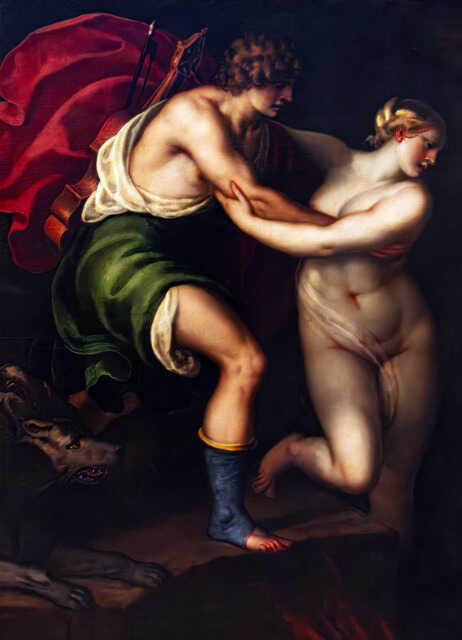
Orpheus and Eurydice, c. 1620
Fuente: https://commons.wikimedia.org/
The secret of a great love story is that the lovers are drawn together like magnets and then torn apart by circumstance. Or, as the Greeks would have it, by Fate. Orpheus and Eurydice were meant for each other but had to pass through Hell before they could be reunited.
Orpheus was a musician and a poet—the John Lennon of the ancient world, if such comparisons can serve. When he played the lyre, birds hushed in the trees, wild beasts paused mid-stride, and Eurydice felt her heart flutter as if an angel had settled behind her ribs. No description can contain the beauty of his music; the only true comparison is Eurydice herself.
Before he met her, Orpheus had wandered far. In Egypt, among desert sands and secret rites, he learned ceremonies unknown even to the Greeks. There he discovered new chords, new ways of weaving words into something like elegiac fire. Returning home, he met Eurydice, and the world clicked into place. They married. They made music. They made love. Their happiness was so radiant it drew the attention of Fate.
One afternoon, as Eurydice walked alone, Aristaeus—a herdsman undone by her beauty—gave chase. Desire curdled into violence. Virgil tells us he meant to rape her. But Fate intervened: she stepped on a viper. The bite saved her virtue and stole her life in the same instant.
Orpheus played on. His mourning was so raw that nymphs and deities wept lakes. He had thought his wandering days finished, yet grief, as so often, became its own compass. He journeyed to the Underworld to retrieve the woman he loved.
At the gates he was confronted by Cerberus, the three-headed hound with a serpent’s tail and a mane of living snakes. The beast had no ear for music, and Orpheus nearly turned back. Then the unexpected happened: Hades and Persephone, moved by the ache in his song, granted him a single chance. He could lead Eurydice back to the living world, but only if he walked ahead and did not look back until both were above ground.
The injunction recalls Genesis: Lot’s wife looked back at Sodom and became a pillar of salt. Orpheus, believing himself stronger than human frailty, pressed on. But desire clouds judgment. As sunlight reached the stones of the passage, he glanced back. Eurydice vanished—twice dead now—slipping like smoke into the darkness he had nearly defeated.
Wandering in despair, Orpheus encountered the Maenads, devotees of Dionysus, drunk on ecstatic frenzy. They tore him apart, though no one says why. In death, his soul descended to Hades, where Eurydice waited. There, finally, they lived a long and happy death.