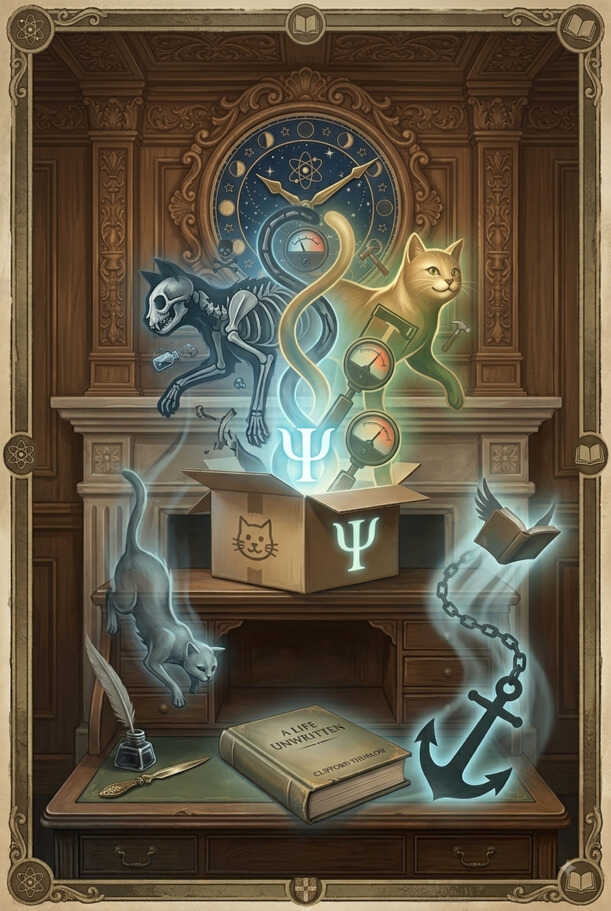
image generated by the AI
You may wonder what my new book and Schrödinger’s cat have in common. The answer is almost certainly nothing at all.
Except that my new book, like Schrödinger’s cat, currently exists in two mutually exclusive states. It may fly high. It may sink like a dead weight. Until publication, both possibilities remain in equal contention.
Long ago, in what now feels like another age, I applied to Cambridge to study English. When the reply dropped through the letterbox, my destiny had been reduced to a single sheet of A4.
While I held the unopened envelope, something peculiar was happening. I was simultaneously a future Cambridge undergraduate and a reject. Both possibilities existed until I opened the letter.
And there it was: not Cambridge. A ‘reject.’
This is where Schrödinger’s cat comes in.
In 1935, Austrian physicist Erwin Schrödinger devised a thought experiment to expose the strangeness of quantum mechanics when its rules are extended from tiny particles to the everyday world.
He imagined a cat sealed inside a box with a radioactive atom, a Geiger counter, a hammer and a vial of poison. The atom has a 50/50 chance of decaying within an hour. If it decays, the counter triggers the mechanism, the hammer falls, the poison is released and the cat dies. If it does not, the cat survives.
Quantum mechanics allows the atom to be described as being in a superposition of decayed and undecayed states before measurement. If we extend that description to the entire apparatus, the cat appears to be in a corresponding superposition of alive and dead.
Hence: Schrödinger’s cat.
The paradox is not really about the cat. Schrödinger was not proposing a cruel new method of pet ownership. He was questioning what happens when the mathematics of quantum mechanics, which works extraordinarily well for the microscopic world, is applied to ordinary objects.
The essential puzzle is this: when does a range of possibilities become one definite reality?
My Cambridge story offers a much less quantum version of the same idea. Before I opened the letter, two futures were possible. But the university had already made its decision. My uncertainty was psychological, not quantum. I simply did not know the answer.
Which brings me back to my book. Until publication, its fate is unknowable. It could soar. It could flop. It could be praised, ignored, admired – and, unlike Schrödinger’s cat, it needs neither the poison or a hammer to determine its fate. It merely needs readers.