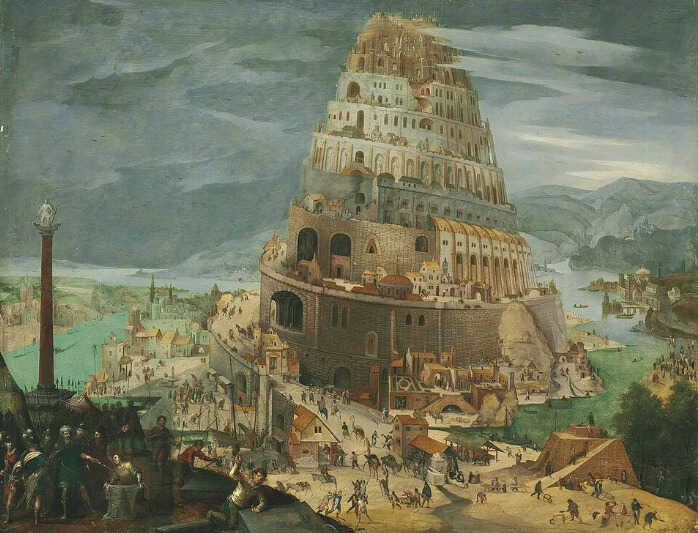
La torre de Babel, 1604
Fuente: https://commons.wikimedia.org/
I arrived late to the concert and had to sit in the last row.
I settled right between two white heads, a couple of what in my city they call “prolonged youth” or “gent grand” (old folks), as they’re known in Catalonia.
Immediately, the music took over the venue.
The couple in front of me were having a touching conversation. They looked at each other, smiled, while they delighted in the notes that floated in the air.
I tried to let my gaze wander through their gestures to see if I could spot my friends who sing in the choir.
Since it wasn’t so easy, I decided to close my eyes and concentrate on the music. The first pieces were in Latin, Laudate Dominum is sanctis ejus…
They continued with melodies in Italian, Dolcissimi respiri de nostri cori amanti…
I opened my eyes for a moment to try again to find my friends and I came across the heads of my adorable old folks once more.
The choir was now moving through verses in German, Einst ruh ew’ge Zeit… and I, in a sublime trance, understood everything the music communicated to me, without needing a translation.
Here is my reflection.
The Tower of Babel came to mind.
According to biblical accounts, the civilization of that time intended to build a colossal tower that would reach the heavens, an act of pride for which God, to stop their arrogance, decided to confuse their languages, thus giving rise to the different languages. Apparently, unable to understand each other, they abandoned the construction and dispersed.
There I was, at my concert, internalizing what the marvelous choir was singing, contemplating the silent language of that pair of eternal lovers, and I came to an important conclusion that perhaps the builders of the Tower of Babel hadn’t considered.
We don’t need to be polyglots to understand each other.
We don’t need to be multilingual to be moved by the sweetest breath.
Music, poetry, love.
In the hall, and in my heart, applauses erupted.
