
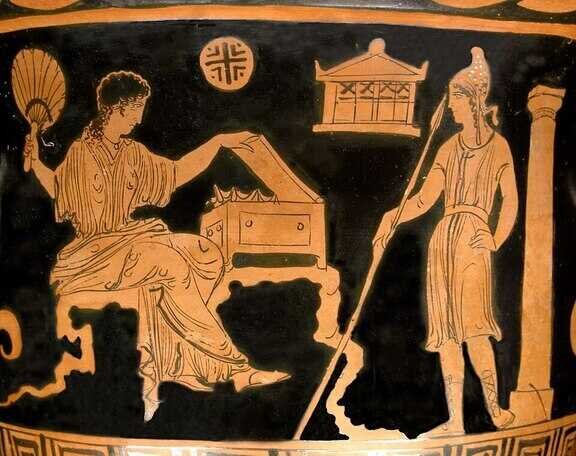
Fuente: https://commons.wikimedia.org/
‘Whom the gods would destroy they first make mad’ is a line often attributed to Sophocles’ Antigone.
Perhaps a more appropriate version for Helen of Troy might be: ‘Whom the gods would destroy they first make beautiful.’ After all, her face, according to legend, launched a thousand ships.
Helen was the daughter of Zeus, king of the gods, which was something of a head start in life. At the age of twelve, she was abducted by Theseus, a man twice her age. Rescued by her brothers, she eventually married Menelaus, king of Sparta, and settled into palace life.
Across the Aegean, Paris, son of King Priam of Troy, was growing into a handsome young man with a rather inflated opinion of himself. When asked to judge a beauty contest between three goddesses, he awarded Aphrodite the golden apple inscribed ‘To the Fairest.’ In return, she promised him the most beautiful woman in the world. There was just one small complication: Helen was already married.
But Aphrodite had made a promise, and Paris was not inclined to let a minor inconvenience stand in his way. He seduced Helen and took her to Troy. Menelaus, understandably unimpressed by this development, assembled a formidable Greek army and sailed across the Aegean to retrieve his wife.
And so began the Trojan War, immortalised by Homer. A decade of bloodshed, heroism, treachery and male posturing, all ostensibly over one unusually beautiful woman. One suspects that Helen herself might have preferred a quieter life.
Achilles, the Greeks’ greatest warrior, eventually met his end when an arrow struck his vulnerable heel. Thus was born the enduring metaphor for a hidden weakness. Even the apparently invincible, it seems, have their Achilles’ heel.
The Greeks, meanwhile, resorted to a rather ingenious deception. Unable to breach Troy’s defences, they concealed soldiers inside an enormous wooden horse, which they presented to the Trojans as a gift. The unsuspecting inhabitants wheeled it into their city, with disastrous consequences. Hence the expression ‘beware of Greeks bearing gifts’ – advice that might usefully have been extended to anyone offering unusually large wooden animals.
Helen’s story, however, is less straightforward than the familiar legend suggests. There are several competing accounts of what happened to her after the fall of Troy. She did not simply return to Sparta, lose her beauty and die of a broken heart – or, for that matter, a broken marriage. Mythology rarely provides a definitive ending.
Perhaps the more interesting question is not whether Helen was the most beautiful woman in the world, but why her beauty became such a powerful instrument of destruction. She was desired, possessed, pursued and fought over, while the men around her made decisions that cost thousands of lives.
Beauty may inspire desire, jealousy and obsession. But it cannot, in itself, launch a thousand ships. Men do that perfectly well on their own.