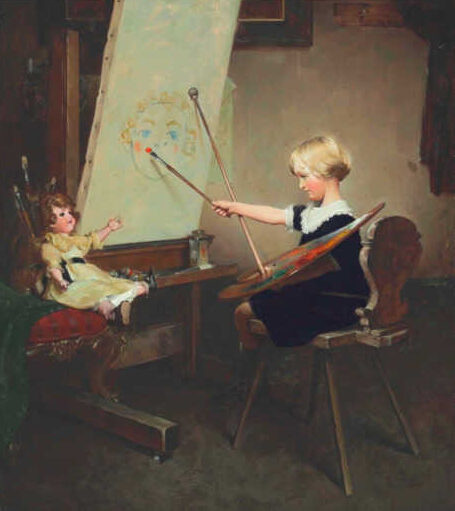
The Artist’s Daughter, 1919
Source: https://www.artera.ae/
We went out to the garden to cut a flower, one of my magical peonies, to be precise, and placed it in a glass vase.
Then we took out our art supplies: canvases, charcoal, pastels, and we started painting.
I give Natalia, my seven-year-old granddaughter, complete freedom. Just a few tips, like squinting to better see the shapes that light and shadows suggest—advice that my painting teacher, Luis Álvarez de Lugo, whom many will remember, used to give me.
The results of Natalia’s artwork always surprise me.
Those unusual color combinations, that wonderful encounter between her and her art.
Children, in their innocence, approach the act of creating—be it painting, writing, or music—with a spontaneity that we adults sometimes wish we had.
Well, that’s how the school holidays began, and with them, the creativity workshops at this grandmother’s house.
I remember that, with my young children, we used to do a similar activity that I called “Forced Poetry Workshop.” I’d make them sit down, suggest a theme like fire or night, we’d brainstorm what each word suggested to them, and then, in silence, each of them would complete their own work of art.
I’m still amazed by the poetic images that came out of those workshops, like: “the fire in the fireplace, painful waterfalls, ash rubbed by wood” (Santiago, ten years old) or, “night dissolves into day because of the sun” (Leonor, eight years old).
I think any creative activity is a good way to keep children away from addictive screens.
So that’s how we’ll spend the summer: one day painting stones, another writing stories or poems. We’ll also play the cuatro, ukulele, or piano.
Imagination is a chain reaction, and in children, it’s a transformative energy that’s contagious.
As a grandmother, I’m happy.
Like Pablo Picasso said:
“Every child is an artist. The problem is how to remain an artist once we grow up.”
